
Dispatches, North America
Interview with Javier Fuentes-León, Director of “Contracorriente”
February 8, 2010 By Jason Farbman
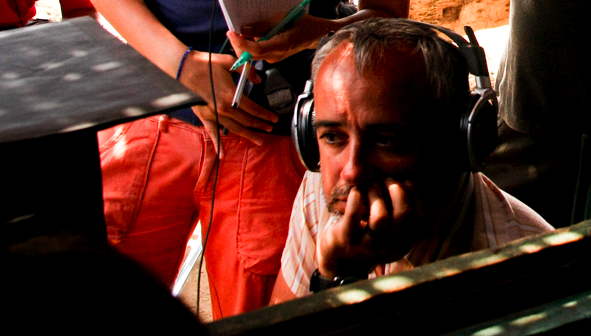
Javier Fuentes-León, director of "Contracorriente"
As the Sundance film festival concluded last week, Javier Fuentes-León took home the Audience Award for World Cinema Drama for his first feature-length film. “Contracorriente” tells the story of Miguel (Cristian Mercado), a fisherman who is expecting his first child with wife Mariela (Tatiana Astengo). At the same time, he has been having a secret affair with a man, Santiago (Manolo Cardona), a visiting painter renting a house in the village. When Santiago drowns, he returns to Miguel as a ghost, and for the first time they are free to express their love without fear. Yet Santiago’s ghost remains trapped in the village until his body is found and properly buried, forcing Miguel to choose between the lies he has told and confronting open homophobia.
Unlike most stories of gay love and openness about one’s sexuality, “Contracorriente” takes place far away from an urban setting. Shot in a remote fishing village in his native Peru, Fuentes-León’s project uses religion and magical realism to create a work that is much more than the sum of premeditated parts. It tackles the complicated issues of honesty about oneself, of machismo and what it means to be masculine in Latin America.
The Latin America News Dispatch had a chance to talk by telephone with Fuentes-León in his home in Los Angeles.
In the past year gay marriage has been legalized in Mexico City and Argentina. In Colombia big steps have been taken in terms of civil union rights. Obviously, when you finish a movie you want to put it out, but is the present a better, more receptive context to release “Contracorriente”? What is your view on the relationship of art to social change?
Fuentes-León: I think cinema can help — art in general — can help change people’s minds. I do think though what will really change people’s minds will always be having somebody else next to them say, “hey, I’m gay.” Somebody they love or admire or respect. And seeing them live their lives as who they are. I don’t want to diminish the power of cinema and art, but I don’t want to overstate it either. This is an issue that we’ve been dealing with for a long, long time. At some points it has been something that’s more accepted, then definitely not, then back again. I’m happy about a lot of the things that are happening in Mexico and Argentina and Colombia and hopefully people will see this film as something they can relate to as a love story and that will help be part of that movement that is making people change their minds. Because I think it’s about time.
We are going to release it in Peru, we are going to release it in Colombia, and we want to release it all over Latin America. We’ll see what the reaction is, but getting into Sundance and winning [the audience award] has already made a big splash of news in Peru and in Colombia. To have that kind of stamp, it’s great, because it says to people “this is a movie you should see.”
You shot “Contracorriente” in a small fishing village in Peru, Cabo Blanco. Do you think that brings an added authenticity?
Fuentes-León: My intention was not to talk about the political context of Cabo Blanco, of a man in this particular town in Peru that deals with being gay or with a homosexual relationship. I don’t even mention that it’s Cabo Blanco — you see it on a few boats, some of them say Cabo Blanco, but I don’t even say it’s Peru. There was even a line that was taken out that talked about Lima, because I wanted it to be an archetype of a town, more than the political and social context of a specific town and country. I guess that’s what helps people connect from other cultures, because it looks like a small town that could be set in South Africa, or Italy, or Colombia, or Thailand, or even maybe Louisiana you could find something like this.
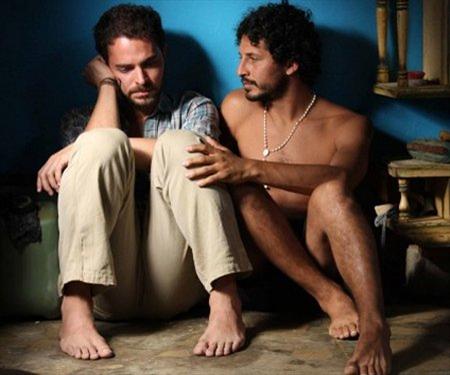
Still from the film "Contracorriente"
Fuentes-León: The guy who plays the painter — the Colombian actor, Manolo [Cardona] — is a huge star in Colombia, but also in Latin America. He was the male lead in Beverly Hills Chihuahua. So there’s an interest on his part in crossing over and coming to the United States. Whereas Christian [Mercado], who is also a very good actor, and very well-known in Bolivia, he’s not actually that known outside his own country. He has an important role in Steven Soderbergh’s Che Guevara movie, in the second film about Bolivia. I think Christian’s aspirations are not to be this big star. For him the pressure was a little less because he didn’t really have this big following of fans. That doesn’t mean it was easier. I think for both of them they were challenging roles, and not just because of the physical aspect.
But for Manolo it was definitely a bigger risk, and people told him not to take it, that this was a career suicide and blah blah blah. But he’s always wanted to be a serious actor and in order to be that he needed to take roles that were not just going to perpetrate the idea that he is a hot, macho guy. Which is what he’s done in the past quite a bit. He’s always been the lover, the mafia guy, the cool detective, you know. He wanted something challenging — which the physical aspect was — but he also has to be vulnerable in this film, be sensitive, he has to be loved and show it. So for him it was a big risk, career-wise. But he’s very proud and has been wanting to support this film and go wherever it’s being shown. So we’re very happy.
In the film, the heterosexual sex scene was shot very differently than those with Miguel and Santiago. Was there a conscious effort to portray these differently because the two male leads are heterosexual?
Fuentes-León: I had in mind the audience that was going to see this film, mainly a Latin American audience. I made this film for as many people as can get to see it, but I had the Latin American audience in mind, and I wanted to highlight the romance and the love between the two men, and be a little bit careful about how much to push that envelope. I didn’t want to lose [the audience], especially because [scenes with Miguel and Santiago] come early in the movie. That’s one side, but on the other hand, in terms of story, when Miguel and his wife have sex, it’s really Miguel trying to prove to his wife and to himself that he is a “man” that he wants to be and she needs him to be. It is a make-up sex, but a “proving that I am a man” sex. It’s not only that I was afraid that one sex needs to be more intense than the other, but storywise it makes sense that Miguel would be more intense with his wife, at that moment in their relationship. That is when he is trying to prove “I have forgotten the other one and I am not gay.”
You told audiences at Sundance that you could not find funding in the United States for a film which dealt overtly with homosexuality and was also in Spanish. Can you talk a bit about how you did get the funding?
Fuentes-León: Some governments — especially in Germany and in France — have some money for project that are not shot in their own country, to help developing countries with their film industries. We got that first funding in Germany because of [the Berlin Film Festival/Berlin Talent Campus]. Which is amazing, because this is Germany, and this German producer is interested in a story in Peru. And I lived in L.A., so there was no connection to Germany whatsoever. And it was through them that we got our first funding. This other company in France heard about it and came to us to read [the script]. They really liked it and applied to this government funding from France which is for industries of developing countries. We got that one too. Ironically, the governments of countries that had nothing to do with Peru were the first ones to support this film.
After that, when you start having a bit more money, people start paying more attention to you. The next chunk of money came from Colombia and Peru around the same time. Peru also has a government fund, and funds five films a year — not completely, but you get like $150,000. Which is how most films are made around the world except in the U.S. and in India. There are some films made with European money that are not dependent on the government, but even then they get benefits for taxes and incentives. Pretty much all the other film industries in the world depend on the governments a lot.
Do you think it’s easier to get a hearing for new voices or ideas when financing comes through the government?
Fuentes-León: Well I think that what is good about all this government funding is that directors have final cut. And in most cases you don’t have to return the money. It’s basically a gift in most cases. In Hollywood if you have private money that is invested in your film, those people need that money returned. And hopefully they gain some money also. So there’s more of a pressure to perform, for these films to connect with an audience and therefore there’s this whole obsession with “Ok, this thing worked, this formula works, this actor works, this genre works. Repeat it.” Where as film makers in France that very much funded by their own government and don’t have to return that money, they have more freedom to fuck it up. Therefore they can do whatever they want.
I’m generalizing of course, but that’s what the French government wants. They take pride in the fact that they’re creating auteurs. Films are made in France with the intention of being commercial successes, but definitely when you have a government that doesn’t ask you to return the money and leaves you alone to make the film you want to make, you are allowed to tell stories that are more out of the norm. I even have a bit of private money from Colombia — quite a chunk of our money came from Colombia — but I was always allowed to do what I wanted. Which was great, and I don’t know if this would have been the case if it had been made — well it would not have been made — under a Hollywood studio. I would not have had that freedom, especially being a first time film maker.
I read that you finished medical school and then decided to pursue film.
Fuentes-León: I had always wanted to be in film. It’s just that when I came out of high school and had to choose a career, that was not an option really. And not because my parents didn’t want me to, but because there wasn’t really any place to study film or even practice. And also in the society in which I grew up, all the men, all the boys would choose the typical five or seven conventional careers. Out of those I chose medicine. I enjoyed studying it, but as I grew older and more mature I realized this is not what I really want to do. So by the time I graduated from medical school, which I had decided I needed to do, I had been accepted into Cal Art [California Institute of the Arts]. I graduated from med school in April 1994 and by September of that same year I was already here studying film. So it wasn’t like I finished medical school and just decided to become a film maker. I had wanted to, but the decision to actually do it took me awhile.
What is your next project going to be?
Fuentes-León: Well it depends on which one gets financed. I have another one that is a love story, this time between a man and a woman. It’s not a forbidden love, but it’s not a love that people understand. The other one I’m about to finish is a film noir, a psychological thriller, that takes place in L.A. I live here so I also want to make films here, but I also want to continue making films in Peru or wherever I can.
View the trailer for Fuentes-León’s “Contracorriente.”
[youtube]http://www.youtube.com/watch?v=gm1-tDY-esU[/youtube]Image: TV Cultura @ Flickr.
About Jason Farbman
Jason Farbman is a Foreign Language/Area Studies Fellow at the Center for Latin American and Caribbean Studies at New York University, where he is comparing class consciousness amongst workers in factory occupations in Argentina and the United States during times of economic crisis. A former Green Party candidate for State Representative in Chicago, Jason has since been an organizer for LGBT rights and in the anti-war movement in Seattle, both in civilian movements and as a close supporter of Iraq Veterans Against the War. Themes of struggle and community are featured in the music he writes and performs under the name Applekicker.
You Might Also Like


Next Article >
7 Comments
[…] He discusses the connection between art and social issues, the financing of the film, masculinity, and more. The url is here: https://latindispatch.com/2010/02/08/interview-with-javier-fuentes-leon-director-of-contracorriente/ […]
Nice commentary. Last Month I found this site and wanted to let you know that I have been gratified, going through your site’s posts. I shall be signing up to your RSS feed and might wait for your next post. Have a good day, Lisa
Thanks for the interview! I loved this movie and have had difficulty finding out much about the director or the actors. This was really a very wonderful amount of information.
I would love to see more pieces in LAND dealing with the Latin cinema which is so wonderfully authentic compared to Hollywood glossy products.
I have nnot seen the movie only parts of it, but these were so tender and well done, that move me deeply. I am peruvian and I understand very well de point o view of the director. Miguel (Mercado) acted to me better in his double paper of husband and defience of the town tradition
just finished watching Undertow & felt it was an exceptional movie, well made, well written, well directed, I’d like to contact Javier Fuentes-Leon to tell him what a great movie he has made. It’s a heart felt film with it content that needed to be told to educate the world of close minded individuals in the hope that one day there will be less hate and more acceptance of everyone. Every human being has the right to live a happy life with out prejudice.
I loved this movie, wel directed. Well acted
Comments are closed.