
Cuba, Dispatches, United States
Cuban Musicians Resuming U.S. Performances
January 13, 2010 By Roque Planas
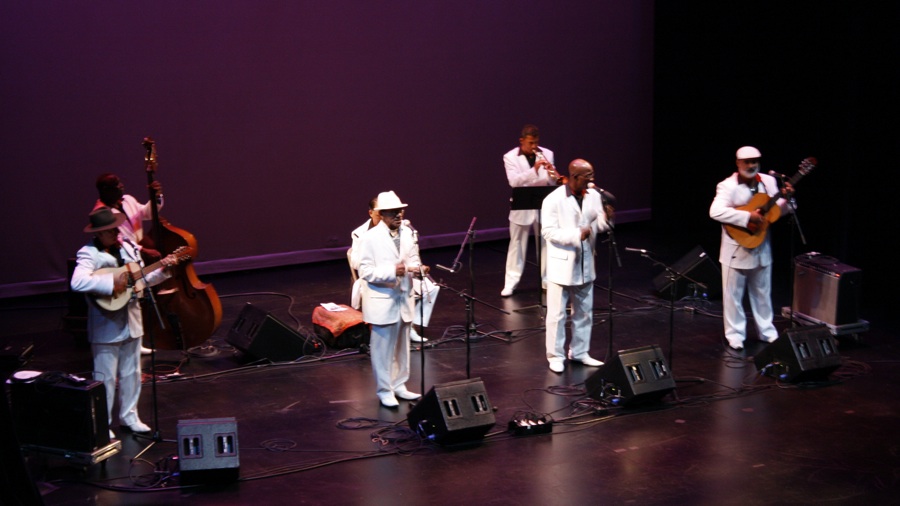
Photo (Roque Planas): The Septeto Nacional performs at the Hostos Center in the Bronx, Nov. 7.
NEW YORK — New York City recently hosted its first Cuban band in five years, after the group Septeto Nacional became the first to win a visa that allowed it to accept a booking there.
The group performed at the Hostos Center for Arts and Culture in the Bronx in early November. It was the first Cuban band to play in New York since 2004, when the Bush administration began systematically denying Cuban musicians cultural exchange visas. The concert kicked off a month-long tour that was taking the band to Puerto Rico, Chicago, Miami and California.
Politics seemed far from the minds of fans as they sang along to the Septeto Nacional classic “Echale Salsita” and clapped to the beat of the clave, the percussion instrument that anchors Cuban rhythm. Indeed, some in the audience made no connection between politics and music.
“Forget about that stuff, Bay of Pigs and all those things, come on man! Give ‘em a break,” said an energetic retired music teacher who asked to be identified only as Papa Frita, or French Fry.
Though no fan of longtime ex-Cuban leader Fidel Castro, he credited Castro for investing in music education.
“Here we’ve got all this rap and people don’t know much. Over there people know how to read music, “ he said. “The best music comes from Cuba.”
“I don’t see any reason why we should keep them out of the country,” listener Jim Buoie said, of Cuban musicians. “The music isn’t dangerous; it’s not a threat. So I think that’s one way to build up understanding between the two countries.”
Thaw?
In the late 1990s and early 2000s, Cuban musicians like the Muñequitos de Matanzas, the Buena Vista Social Club and Los Van Van played regularly in the United States. The Hostos Center brought “maybe 10 groups” from Cuba between 1996 and 2003, according to Director Walter Edgecombe.
Then, in early 2004, the Bush administration stopped approving cultural exchange visas for musicians, without ever announcing an official policy change. The measure coincided with general tightening of the half century-old U.S. trade embargo against Cuba. Cuban-Americans’ ability to travel to Cuba or send money to relatives living there was restricted, and long-ignored laws prohibiting the Cuban government from circulating the dollar began to be enforced.
“After that, we didn’t bring any Cuban groups up,” Edgecombe said. “Since they were employees of the state, they were deemed to be Communist or anti-American or whatever, I don’t know.”
Likewise without announcing any shift, the Obama administration began approving Cuban cultural exchange visas in October 2009. The U.S. State Department approved Cuban folk singer Pablo Milanés’ visa to play a concert in Puerto Rico. Singer Omara Portuondo became the first Cuban ever to come to the United States to receive a Latin Grammy award, after her album “Gracias” was awarded “Best Tropical Music Performance.”
U.S. government officials have not clarified whether these changes augur a broader reevaluation of U.S. policies toward Cuba.
“We are neither actively promoting nor actively impeding these artistic exchanges,” a State Department official told The New York Times last fall.
Cuba, with Iran, Sudan and Syria, is one of four countries on the U.S. government’s “state sponsors of terrorism” list for allegedly supporting rebels in Colombia and Spain, and for refusing to extradite U.S. citizens wanted by U.S. authorities.
The blacklist status makes applying for a cultural exchange visa tedious, according to a report music scholar Ned Sublette produced for the Cuba Research and Analysis Group (CRAG), a group that supports U.S.-Cuba cultural exchanges.
Cuban musicians must first present an application to the U.S. Interests Section in Havana—the diplomatic mission the U.S. government maintains in Cuba instead of an embassy. The sponsoring venue generally pays $1,000 to expedite the process, though it can still drag on for months. Then the application is turned over to the State Department for security clearance. Since 2004, most such applications have died there.
San Francisco attorney Bill Martínez, who ushered through Septeto Nacional’s visas, called the group’s approval “a breakthrough.” But Martinez, who has specialized in Cuban cultural exchange visas since 1983, is cautious about what that augurs for future visits.
“We’re glad we can finally get anybody in,” he said. But he “had nail-biting moments” with Septeto Nacional, whose visa too eight months to secure. He said the group had nearly been rejected on the grounds that it wasn’t “culturally unique.”
The long legacy of the Cold War has set the entry barrier higher for Cubans than for visitors from nearly anywhere else, said Robert Browning, of New York City’s World Music Institute.
“We’ve consistently brought in people from the so-called ‘Evil Axis’ countries,” he said, referring to Bush’s notorious label for Iraq, Iran and North Korea. The Cuba policy is “just kind of left over” from the 1960s, he said.
Clubs and theaters are reluctant to promote shows that might be canceled if visas are denied, or approved too late. So, despite apparently thawing U.S. policy, Cuban bands aren’t seen as likely to flood into the United States any time soon.
“I think that the Obama administration has made it clear that they would like to see more cultural relations,” said Sublette, in a telephone interview. But until the “arcane system” of approvals is changed, it will always be financially hazardous for U.S. venues to work with Cuban musicians, he added. “One can only hope that it will get a lot easier.”


6 Comments
[…] the articles in the Latin America News Dispatch and the New York Times for more details about how music exchanges are changing the face of […]
[…] This post was mentioned on Twitter by USC Public Diplomacy and Cuba Travel USA, LatAmNews Dispatch. LatAmNews Dispatch said: Cuban Musicians Resuming U.S. Performances: NEW YORK — New York City recently hosted its first Cuban ban.. http://bit.ly/69NE2f […]
[…] the articles in the Latin America News Dispatch and the New York Times for more details about how music exchanges are changing the face of […]
[…] In a press conference Tuesday morning at lower Manhattan’s Sound’s of Brazil club, Rodriguez gave a matter-of-fact explanation for his three decades-long absence from the United States: “They wouldn’t grant me a visa,” he said, alluding to troubles he had earlier this year when he was invited to the U.S. for a tribute to folk musician Pete Seeger and was unable to obtain a visa in time. […]
[…] In a press conference Tuesday morning at lower Manhattan’s Sound’s of Brazil club, Rodriguez gave a matter-of-fact explanation for his three decades-long absence from the United States: “They wouldn’t grant me a visa,” he said, alluding to troubles he had earlier this year when he was invited to the U.S. for a tribute to folk musician Pete Seeger and was unable to obtain a visa in time. […]
[…] Social Club will miss the first in a series of three planned shows in the United States because of visa delays, their lawyer announced on […]
Comments are closed.