Haiti Earthquake: Dominicans Give, But Hard Feelings Remain

January 26, 2010 2:58 am 4 comments

Jose Tavares

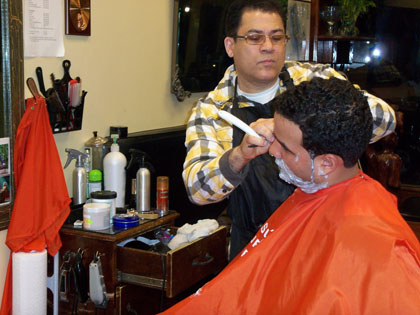
NEW YORK — Fifteen minutes after he heard about the earthquake in Haiti, Dominican barber Jose Taveras said he made a donation to the Red Cross. Taveras was born in the Dominican Republic, a country that shares the island of Hispaniola with Haiti.

“I consider Haiti a part of my country,” Taveras said through his friend Jay Hernandez, who acted as his interpreter. “We are one people.”

But not every Dominican feels that way. Taveras admits the two countries have not always gotten along. He said the Haitian occupation of the Dominican Republic between 1821 and 1843 is a source of resentment between the two nations. Even so, the owner of Groom Team barbershop in Washington Heights insists any grudges between Haitians and Dominicans have been buried, at least in his mind.

“That’s in the past,” Taveras said. “It’s not something we think about now.”

Dominicans in Washington Heights expressed remorse for the devastation and lives lost after the Jan. 12 quake, but some, unlike Taveras, did not paint a rosy picture of the current relations between the two countries. Victor Sangiovanni, whose father still lives in the Dominican Republic, says illegal Haitian immigrants in the D.R. are a continuing cause of frustration.

The Christian Science Monitor estimates that, in 2009, between 700,000 and 1 million illegal Haitian immigrants were living in the D.R. Most, according to the Monitor, come seeking economic opportunities, often in the construction industry.

“I don’t really like Haitians,” Sangiovanni said. “They keep trying to take over our country, and we keep having to send them back.” Despite his distaste for illegal Haitian immigrants, Sangiovani’s eyes widen with surprise when asked whether he’s donated money to the relief effort. “Of course,” he said. “They live so close to where I come from. I would hope they would do the same for us if an earthquake happened in the Dominican.”

Nicholas Gomez insists it’s no coincidence that Haiti was ravaged by a natural disaster while the Dominican was spared. He contends that belief in Catholicism, the primary religion practiced in the Dominican, spared his home country from catastrophe. “God is watching out for us,” Gomez said. “When you have God, you don’t have to worry about anything.”

Gomez said Haitians believe in voodoo and “worship the devil.” He stops short of claiming that practicing voodoo is what caused the earthquake, but he says Haitians must be careful who they pledge allegiance to.

“The devil will trick you,” Gomez said. “Haiti is living in the dark. They are moving in the wrong direction.”

Contrary to Gomez’ assertions, a 2008 United Nations report on national religions found that only 2 percent of Haitians practice voodoo. Further, those who believe in Haitian voodoo do not typically worship the devil. The primary deity in the religion is Bondye, whose name is derived from the French “bon Dieu” or “good God.” The U.N. report found that 55 percent of those living in Haiti are Roman Catholic.

Although he condemns what he claims are Haitian religious practices, Gomez said he made a donation to Catholic Relief Services, an international aid group contributing to the relief effort. Like Taveras, Gomez explains that geographical proximity fosters a feeling of brotherhood between the two countries.

“We feel like we are a part of them,” Gomez said. “They are like our relatives.”

Doyanica Pineda bristles at the notion that God had anything to do with the disaster, which has claimed an estimated 200,000 lives. The nurse, whose family resides in the Dominican, said it was purely a matter of chance that Haiti was struck.

“Some people say God is the one who made the earthquake happen,” Pineda said. “I don’t believe that at all. God is not responsible for this.”

Image (Simon McCormack): Jose Taveras gives Jay Hernandez a shave inside Groom Team barbershop in Washington Heights. Taveras contends Dominicans and Haitians no longer bare resentment toward one another, but other Dominicans disagree.

This article was originally published by Pavement Pieces.

4 Comments

  • rita ros-planas

    Compassionate, well-written piece that dispels the erroneous stereotypical view of Haitians as voodoo devil worshipers, but does so in a respectful, informative manner.

    One little typo that got through spellcheck–it’s “bear” not “bare resentment” in the last paragraph.

    Muchas gracias!

  • Henry Pastrano

    Even though some minority groups may think different, the vast majority of the dominican people get along with our haitian neighbor, which was demonstrated when the earthquake struck earlier in this month and immediately all of the available resources were use to help Haiti, both by our goverment as by particular individuals, and as of today our hospitals are full of injured haitians and there are thousands of Dominican volunteers working in Port au Prince and other locations damaged by teh quake.

    The PAT ROBERTSONIAN position indicated in your article is shared only by a very little minority mainly older uneducated people.

  • Actually, saying that haitians practice or are voodoo worshipers is not steriotype at all, that’s a fact. Also, dominicans don’t feel that haiti is part of the dominican republic or that haitians are our “brothers”, but that doesn’t mean we shouldn’t help them. It is part of our culture to help our neighbors.

  • That cheap labor is sure good, also the sugar cane.

Leave a Reply


Other News

  • Brazil News Briefs Southern Cone Brazil’s Truth Commission Set To Begin Its Work

    Brazil’s Truth Commission Set To Begin Its Work

    Brazilian President Dilma Rousseff will preside over an official ceremony Wednesday to launch Brazil’s Truth Commission. The seven-member commission will convene for two years to investigate human rights abuses committed in Brazil between 1946-1988, focusing on the country’s 1964-1985 military dictatorship. Rousseff, who endured torture as a political prisoner during the dictatorship, has made it clear that she intends to present the Truth Commission as a multi-partisan effort with broad support in Congress and across social sectors. The commission was created after [...]

    Read more →
  • Andes Colombia Today in Latin America Bombing In Bogotá Kills Two, Injures Dozens More

    Bombing In Bogotá Kills Two, Injures Dozens More

    Top Story –  A driver and a police bodyguard for former Colombian Interior Minister Fernando Londoño were killed after a bomb went off in Bogotá on Tuesday, injuring dozens of other people. Lodoño was traveling through a commercial district when an assailant allegedly threw a bomb at his car, according to security camera footage mentioned by Bogotá Mayor Gustavo Petro. Colombian authorities had discovered another bomb earlier Tuesday, hidden in a car allegedly destined for police headquarters in Bogotá, but they managed [...]

    Read more →
  • Caribbean Cuba Today in Latin America Judge Rejects Declassification Of CIA Volume On Bay of Pigs

    Judge Rejects Declassification Of CIA Volume On Bay of Pigs

    Top Story – A U.S. federal judge rejected an effort by the National Security Archive to declassify the CIA’s fifth and final volume on the history of the U.S. Bay of Pigs invasion of Cuba. The volume, the last in the CIA’s Official History of the Bay of Pigs, was written over three decades ago and details the CIA’s internal investigation of the failed Bay of Pigs operation in April 1961, in which the U.S. unsuccessfully attempted to overthrow Fidel Castro’s government in Cuba. Judge Gladys Kessler [...]

    Read more →
  • Andes Colombia Today in Latin America Colombia: FARC Plans To Release French Journalist

    Colombia: FARC Plans To Release French Journalist

    Top Story — Red Cross officials said Sunday that the Revolutionary Armed Forces of Colombia (FARC) guerrillas have agreed to release French journalist Romeo Langlois, who was captured by the rebels while he was embedded with Colombian troops on April 28. The soldiers were in the process of destroying cocaine laboratories in southern Colombia when they were confronted by the rebels, who reportedly killed four members of the Colombian security forces. The head of the ICRC in Colombia said the Red [...]

    Read more →
  • Chile Southern Cone Today in Latin America Chilean Congress Approves “Zamudio Law” Against Discrimination

    Chilean Congress Approves “Zamudio Law” Against Discrimination

    Top Story – Chile’s Congress passed a long-delayed anti-discrimination law on Wednesday night in a vote of 25-3, seven years after the law was initially introduced and more than two months after 24 year-old gay Chilean Daniel Zamudio was beaten in a violent attack from which he eventually died. Zamudio’s murder prompted thousands of Chileans, including Chilean President Sebastián Piñera, to call for expedited passage of the anti-discrimination law that had been languishing since it was approved by the Senate in [...]

    Read more →
  • Central America Honduras Today in Latin America Honduras: Second Journalist Kidnapped in One Week

    Honduras: Second Journalist Kidnapped in One Week

    Top Story — Honduran radio journalist Angel Alfredo Villatoro was kidnapped Wednesday just a few days after authorities discovered the body of another journalist, Erick Martínez, on the side of a road in eastern Honduras. Witnesses of the kidnapping reported that Villatoro was taken by “young gang members” at dawn on his way to work at HRN radio station in Tegucigalpa. The Honduran government and HRN colleagues have issued statements pleading that Villatoro’s captors release him unharmed. Meanwhile, little information has emerged [...]

    Read more →
  • Caribbean Puerto Rico Today in Latin America Puerto Rico Governor: Students Should Speak Fluent English by 2022

    Puerto Rico Governor: Students Should Speak Fluent English by 2022

    Top Story – Puerto Rican Governor Luis Fortuño has proposed an ambitious plan to make Puerto Ricans bilingual in English and Spanish by the year 2022, an effort that he hopes will pave the way for U.S. statehood. Fortuño wants public schools to teach all classes in English, with the exception of Spanish literature and grammar instruction. English is currently taught from kindergarten through high school, but Education Secretary Edwin Moreno said the government would begin to introduce a new bilingual curriculum  at 31 [...]

    Read more →
  • Andes Colombia Today in Latin America Colombia May Regulate Prostitution Following Scandal

    Colombia May Regulate Prostitution Following Scandal

    Top Story – Colombian politicians have proposed a new bill that would regulate prostitution in Colombia, reacting to the scandal that erupted in Cartagena last month when members of the U.S. Secret Service reportedly hired prostitutes before the Summit of the Americas. Conservative Senator Armando Benedetti proposed the bill on Monday, noting that prostitution would remain legal in Colombia, but that the new law would “guarantee labor rights and public health”. It’s not clear whether the bill would pass, but Colombia’s Catholic church remains [...]

    Read more →
  • Argentina Southern Cone Today in Latin America Argentine Ad For London Olympics Angers IOC

    Argentine Ad For London Olympics Angers IOC

    Top Story – The International Olympic Committee (IOC) sent a letter to the Argentine Olympic committee after an Argentine ad promoting the 2012 London Olympics made a controversial reference the Falkland Islands. The ad, which first aired in Argentina on Wednesday, showed scenes of Argentine field hockey captain Fernando Zylberberg training in the Falkland Islands, followed by the statement, ”To compete on British soil, we train on Argentine soil.” Argentina and Britain recently marked the 30th anniversary of the Falklands War, and both countries still [...]

    Read more →
  • Caribbean Cuba Today in Latin America IKEA Used Cuban Dissidents to Manufacture Furniture: Report

    IKEA Used Cuban Dissidents to Manufacture Furniture: Report

    Top Story — Already in deep water over allegations that it used prisoners from the former East Germany to make its products, Swedish home furnishing giant IKEA now faces charges that it employed Cuban dissidents as well. According to the German newspaper Frankfurter Allgemeine Zeitung (FAZ), former Stasi secret police files revealed that IKEA struck a deal with the Castro government in 1987 after an East German trade mission went to Havana for talks with the Cuban interior ministry. The Stasi files [...]

    Read more →