Ollanta Humala Proposes A Nationalist Program As A Response To Globalization

October 25, 2010 6:23 am 2 comments

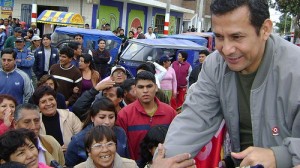
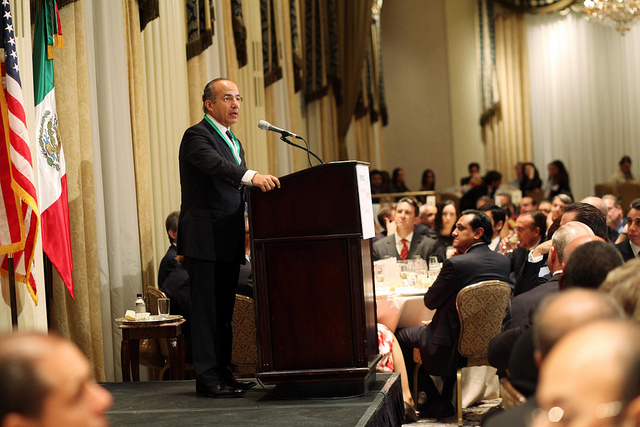
Presidential candidate for the Peruvian Nationalist Party Ollanta Humala.

NEW YORK – Nationalism offers Peru the best way of accommodating itself to an increasingly globalized world, presidential candidate for the Peruvian Nationalist Party Ollanta Humala said Thursday.

Speaking at an event organized by the Observatory Latin America at the New School, Humala outlined a nationalist program designed to transform Peru from a mineral exporting nation to an industrial nation that privileges the internal market.

The plan rests on the principle of increasing state capacity. “The state must be strong in all areas of the national territory,” Humala said, arguing that part of the state’s role should be to act as a check against what he described as “monopolies that discourage competition.”

“What we need is an honest state that can provide protections for investment,” Humala said. “The only entity that can protect and defend us is the state.”

The weakness of the Peruvian state leaves the field open for drug cartels and extremist groups like the Sendero Luminoso to operate, Humala added.

In areas of Peru where the state is weak or absent, Humala said, mining companies negotiate directly with community leaders, who might ask the company to build a road, a bridge, or a school. “In other words, that person is saying, ‘we don’t have a state, we’re orphans.’ If you arrive with money, you are the state.”

Humala also spoke several times of an “educational revolution,” though he did not mention details of the plan, beyond saying that it would focus on science and technology.

Humala viewed educational improvement as a means to add value to Peruvian labor. “Peru is not preparing to insert itself into the globalized world,” Humala said.

Humala is campaigning for the Peru’s 2011 presidential elections. He also ran in 2006, when he lost to current president Alán García. At the time, Humala’s detractors painted him as a radical aligned with Venezuelan socialist Hugo Chávez who would scare off foreign investment.

The international community has praised President García for his economic gains and poverty reduction.

But Humala criticized García’s economic plan, saying it reinforced a pattern of colonialism, in which Peru’s mineral resources were exported and the country’s main comparative advantage in the world market was its ability to offer cheap labor.

Humala pointed out that during Peru’s recent periods of economic growth, immigration levels have risen. “The pattern should be the opposite,” Humala said. “Something is not right.”

Humala also said Peru’s history of colonialism was responsible for the country’s notoriously skewed distribution of wealth.

“It’s like as if I had 10 children and I decided to support only one and leave the others abandoned,” Humala said.

Humala has struggled since the 2006 elections to present himself as a patriot devoid of ideology, whose politics are “neither left nor right.” At the talk, he said the debate about South America’s ideological divide reminded him of the Cold War era.

But some continue to associate him with the region’s leftist leaders. A member of the audience told Humala that she worried about the country adopting a socialist economic model inspired by Cuba.

“We respect the right to property,” Humala responded. He added that the root of the problem that led to the outbreak of violence between police and indigenous protesters in Bagua in June 2009 was the Peruvian government’s lack of respect of indigenous territorial rights.

Humala’s nationalist vision was not limited to economics, however. He also proposed a residency requirement for running for president and said he hoped one day the objects brought to the United States by American explorer Hiram Bingham from Machu Picchu would be returned.

The Peruvian government has been involved in negotiations with Yale University since 2007 to have objects from Bingham’s 1912 expedition repatriated, according to a document posted to Yale’s Web site.

While Humala emphasized nationalism at the talk, his brand of nationalism was curiously international. He called for the “integration of Latin American peoples,” and voiced support for the region’s multilateral institutions, including the Venezuelan-led Boliviarian Alliance for the Americas (ALBA) and the  common markets of MERCOSUR and the Andean Community.

He recalled that when the Spanish divided Latin America into administrative units, the royal government ripped apart preestablished nations. “These are states that have no reason for existing,” Humala said.

Image: Courtesy of the Partido Nacionalista Peruano.

2 Comments

  • Information transmitted thru article promotion should be both well-timed and useful for the prospect browsing your articles.

  • I am not not used to blogging and really treasure your internet site. There is much original subject that peaks my interest. My goal is to bookmark your internet site and keep checking you out.

Leave a Reply


Other News

  • Central America Honduras Today in Latin America Kidnapped Honduran Radio Journalist Found Murdered

    Kidnapped Honduran Radio Journalist Found Murdered

    Top Story – Honduran police have arrested a suspect in the murder of kidnapped RHN radio journalist Alfredo Villatoro, whose body was discovered in Tegucigalpa late Tuesday. Villatoro, a prominent Honduran journalist and news director for RHN, was kidnapped early Wednesday on his way to work. His family and colleagues urged Villatoro’s kidnappers to release him unharmed, but he was found shot in the head nearly a week after his disappearance, wearing a police uniform, not the clothing he had on when he was [...]

    Read more →
  • Brazil News Briefs Southern Cone Brazil’s Truth Commission Set To Begin Its Work

    Brazil’s Truth Commission Set To Begin Its Work

    Brazilian President Dilma Rousseff will preside over an official ceremony Wednesday to launch Brazil’s Truth Commission. The seven-member commission will convene for two years to investigate human rights abuses committed in Brazil between 1946-1988, focusing on the country’s 1964-1985 military dictatorship. Rousseff, who endured torture as a political prisoner during the dictatorship, has made it clear that she intends to present the Truth Commission as a multi-partisan effort with broad support in Congress and across social sectors. The commission was created after [...]

    Read more →
  • Andes Colombia Today in Latin America Bombing In Bogotá Kills Two, Injures Dozens More

    Bombing In Bogotá Kills Two, Injures Dozens More

    Top Story –  A driver and a police bodyguard for former Colombian Interior Minister Fernando Londoño were killed after a bomb went off in Bogotá on Tuesday, injuring dozens of other people. Lodoño was traveling through a commercial district when an assailant allegedly threw a bomb at his car, according to security camera footage mentioned by Bogotá Mayor Gustavo Petro. Colombian authorities had discovered another bomb earlier Tuesday, hidden in a car allegedly destined for police headquarters in Bogotá, but they managed [...]

    Read more →
  • Caribbean Cuba Today in Latin America Judge Rejects Declassification Of CIA Volume On Bay of Pigs

    Judge Rejects Declassification Of CIA Volume On Bay of Pigs

    Top Story – A U.S. federal judge rejected an effort by the National Security Archive to declassify the CIA’s fifth and final volume on the history of the U.S. Bay of Pigs invasion of Cuba. The volume, the last in the CIA’s Official History of the Bay of Pigs, was written over three decades ago and details the CIA’s internal investigation of the failed Bay of Pigs operation in April 1961, in which the U.S. unsuccessfully attempted to overthrow Fidel Castro’s government in Cuba. Judge Gladys Kessler [...]

    Read more →
  • Andes Colombia Today in Latin America Colombia: FARC Plans To Release French Journalist

    Colombia: FARC Plans To Release French Journalist

    Top Story — Red Cross officials said Sunday that the Revolutionary Armed Forces of Colombia (FARC) guerrillas have agreed to release French journalist Romeo Langlois, who was captured by the rebels while he was embedded with Colombian troops on April 28. The soldiers were in the process of destroying cocaine laboratories in southern Colombia when they were confronted by the rebels, who reportedly killed four members of the Colombian security forces. The head of the ICRC in Colombia said the Red [...]

    Read more →
  • Chile Southern Cone Today in Latin America Chilean Congress Approves “Zamudio Law” Against Discrimination

    Chilean Congress Approves “Zamudio Law” Against Discrimination

    Top Story – Chile’s Congress passed a long-delayed anti-discrimination law on Wednesday night in a vote of 25-3, seven years after the law was initially introduced and more than two months after 24 year-old gay Chilean Daniel Zamudio was beaten in a violent attack from which he eventually died. Zamudio’s murder prompted thousands of Chileans, including Chilean President Sebastián Piñera, to call for expedited passage of the anti-discrimination law that had been languishing since it was approved by the Senate in [...]

    Read more →
  • Central America Honduras Today in Latin America Honduras: Second Journalist Kidnapped in One Week

    Honduras: Second Journalist Kidnapped in One Week

    Top Story — Honduran radio journalist Angel Alfredo Villatoro was kidnapped Wednesday just a few days after authorities discovered the body of another journalist, Erick Martínez, on the side of a road in eastern Honduras. Witnesses of the kidnapping reported that Villatoro was taken by “young gang members” at dawn on his way to work at HRN radio station in Tegucigalpa. The Honduran government and HRN colleagues have issued statements pleading that Villatoro’s captors release him unharmed. Meanwhile, little information has emerged [...]

    Read more →
  • Caribbean Puerto Rico Today in Latin America Puerto Rico Governor: Students Should Speak Fluent English by 2022

    Puerto Rico Governor: Students Should Speak Fluent English by 2022

    Top Story – Puerto Rican Governor Luis Fortuño has proposed an ambitious plan to make Puerto Ricans bilingual in English and Spanish by the year 2022, an effort that he hopes will pave the way for U.S. statehood. Fortuño wants public schools to teach all classes in English, with the exception of Spanish literature and grammar instruction. English is currently taught from kindergarten through high school, but Education Secretary Edwin Moreno said the government would begin to introduce a new bilingual curriculum  at 31 [...]

    Read more →
  • Andes Colombia Today in Latin America Colombia May Regulate Prostitution Following Scandal

    Colombia May Regulate Prostitution Following Scandal

    Top Story – Colombian politicians have proposed a new bill that would regulate prostitution in Colombia, reacting to the scandal that erupted in Cartagena last month when members of the U.S. Secret Service reportedly hired prostitutes before the Summit of the Americas. Conservative Senator Armando Benedetti proposed the bill on Monday, noting that prostitution would remain legal in Colombia, but that the new law would “guarantee labor rights and public health”. It’s not clear whether the bill would pass, but Colombia’s Catholic church remains [...]

    Read more →
  • Argentina Southern Cone Today in Latin America Argentine Ad For London Olympics Angers IOC

    Argentine Ad For London Olympics Angers IOC

    Top Story – The International Olympic Committee (IOC) sent a letter to the Argentine Olympic committee after an Argentine ad promoting the 2012 London Olympics made a controversial reference the Falkland Islands. The ad, which first aired in Argentina on Wednesday, showed scenes of Argentine field hockey captain Fernando Zylberberg training in the Falkland Islands, followed by the statement, ”To compete on British soil, we train on Argentine soil.” Argentina and Britain recently marked the 30th anniversary of the Falklands War, and both countries still [...]

    Read more →