
Dispatches, United States
Hispanic Voices Become More Influential As Midterm Elections Approach
November 1, 2010 By Von Diaz

New York City Coucilwoman Melissa Mark-Viverito. Image by Von Diaz.
NEW YORK— Immigration has become a divisive topic in the upcoming mid-term elections, prompting speculation that the slow pace of proposed immigration reform legislation has disillusioned Hispanics enough to make them reconsider voting.
But regardless of the outcome in the midterm elections, the panic induced by the possibility of Latinos not voting reveals how the Latino voice has grown in importance.
Patricia Guadalupe of the National Association of Latino Elected Officials (NALEO) responded to recent polls claiming that Latino voter engagement is lacking in tomorrow’s mid-term elections.
“Latinos are listening and need to be taken seriously,” Guadalupe said by phone. She added that NALEO is encouraging Latinos to “go vote, and show the White House and Congress that we need to be paid attention to.”
Immigration has become a sore spot for the Obama administration. In 2008 President Barack Obama promised to make immigration reform a top priority. At the 2008 Democratic Convention, he inspired Latinos across the nation, when he said “passions fly on immigration, but I don’t know anyone who benefits when a mother is separated from her infant child.”
But the comprehensive immigration reform President Obama promised hasn’t materialized. Latino voters, often credited with securing Obama’s election in 2008, want answers.
“We get overpromised all the time,” said New York City Councilwoman Melissa Mark-Viverito.
“Immigration reform hasn’t been addressed, and it’s a big issue that reinforces cynicism,” added Mark-Viverito, whose district includes the predominantly Latino neighborhood of East Harlem (also known as Spanish Harlem and El Barrio).
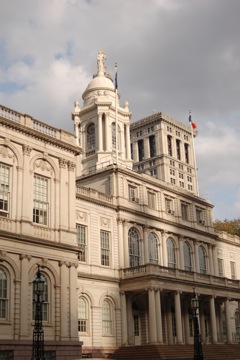
New York City Hall. Image by Von Diaz.
Mark-Viverto’s comments reflect a pervasive feeling of disappointment among Hispanics nationwide.
Immigration is a political flashpoint, but according to the Pew Hispanic Center, a nonpartisan research organization focused on the Latino population in the United States, recent polls show that Latinos are more concerned with other issues.
The Pew Hispanic Center’s September 2010 report shows education as the most important issue for registered Latino voters, followed by jobs and healthcare. Surprisingly, immigration ranks fifth.
The Pew report also reflects a lack of Latino voter engagement. Only 32 percent of registered Latino voters have seriously considered the mid-term elections, contrasted with 50 percent of all voters.
The passing of Arizona’s controversial immigration law SB 1070—which requires people in the state to carry citizenship documentation at all times—and the possibility of similar legislation in other states, has made the potential absence of Latino voters worrisome to immigration reform proponents.
In contrast, NALEO reports different numbers. “Our polls show that an overwhelming majority have every intention of voting,” Guadalupe of NALEO said.
“Riled,” “restless,” and “ready”—these are the words used by NALEO to describe Latinos in the coming election. In a report published in July 2010, polls show that 6.5 million Latinos in the United States plan to vote.
One explanation for the disparities in these polls could be different motives for the research they present. The Pew report’s sample included registered Latino voters, as well as those not registered, giving a broad look at Latino public opinion regarding the upcoming elections.
NALEO polled registered Latino voters in California, Colorado, Florida, and Texas—states with senatorial or gubernatorial races classified as “open” or “competitive.” The NALEO report, therefore, focuses primarily on states where the Latino vote will make the largest impact.
The Pew Hispanic Center reports that 51 percent said they are absolutely certain they will vote. NALEO, in contrast, reports that 61 percent of voters said they definitely will. Together, these reports—however different—present statistics comparable to those in the 2008 presidential primaries, where 56 percent of Latinos voted.
Immigration may not be the only important issue for Latino voters, but it influences Latino voter participation. The Pew report shows 66 percent of Latinos overall, and 58 percent of registered voters who intend to vote discussed the immigration debate within the last year. In contrast, only 39 percent of registered voters who hadn’t discussed the immigration debate were certain they would vote.
Another trend highlighting the increasing political importance of Hispanics is the steady increase of Latino elected officials. Between 1996-2010, Latino elected officials in the United States increased by 39 percent, from 3,743 to 5,739. This increase was even greater in the federal government, where the increase was 53 percent.
As the number of Latino elected officials in the United States continues to increase, so too will emphasis on issues important to the Latino community.
Jerry Gonzalez of the Georgia Association of Latino Elected Officials confirmed a nationwide increase in Latinos holding public office.
“With the demographic changes that are taking place, and the upcoming release of the U.S. census, focus on the wellbeing and advancement of the Latino community will increase. There will be a need for more Latino elected officials to meet the needs of the growing community,” Gonzalez said by phone.
While there are more Hispanics in public office, but the number of Hispanic women elected officials has not increased. “We’ve definitely seen a uptick, with more Latinas entering the pipeline. But the success rate is not increasing,” said Helen Torres, executive director of Hispanas Organized for Political Equality.
According to Torres, the primary barrier for Latina women who want to run for public office is self-doubt. “If you ask [Latino] men and women if they are prepared for public office, two to one women say no, and two to one men say yes.”
The pathways to public office for Latinos have changed substantially in the last decade, with Supreme Court Justice Sonya Sotomayor serving as an extraordinary example. Numerous experts in Latino electoral politics identified Justice Sotomayor as an important role model for Latinos, an example of what is attainable.
“When you look at her background, that she was born and raised in the Bronx, has a working class background, and has gotten so far—it’s very inspiring,” said Coucilwoman Mark-Viverito.
About Von Diaz
Von Diaz is a native of Puerto Rico and spent most of her life in Atlanta, GA. Von is a graduate of Agnes Scott College, where she earned a B.A. in Women’s Studies and focused her research on women in Latin America and the developing world. She has worked in community advocacy and communications for a variety of nonprofit organizations focused on women and children. She now holds a dual M.A. in journalism and Latin American and Caribbean studies at New York University.


4 Comments
[…] Hispanic voices are becoming more influential as the mid-term elections approach, reports Von Diaz. […]
Man I used to love Obama and his party, even I bought his poster and was for long time on the wall. But since his party has sent me home, keeping me away from my 2 y.o. daughter, I’m done with all this crap.
Again, they lied to me first time- shame on them, but if I let them lie to me second time- would be shame on me. That’s why I don’t believe on Obama anymore- just tired of lip service, and no action. If I could tell to all of latinos- in the Immigration jail, we were treated as terrorist- no food, no telephones, no access to attorney- and I’m not a criminal, I’m with M.D. degree came from Europe as a political asylee, please on behalf of all of the 350 thousand people who Obama has deported ( a record in the US history,… ever) …DO NOT LET THEM FOOL YOU, THEY NEED YOUR VOTE SO THEY CAN LIVE A HAPPY LIFE, WHILE OUR CHILDREN WILL SPEND CHRISTMAS WITH NO DADDY AND GIFTS. @#$% with them!
I have no respect for him, neither for his party!…PERIOD!!!!
Which party controls Congress? that your White House? The answer reveals the actual “balance of power” between the 2 branches of government who have elected officials. Contrary that will popular belief, most of times in modern political history Congress and the President have been from odds; that is, a similar political party has not necessarily typically controlled the bright House, the Senate, plus the House of Representatives. Only 10 times since 1945 have both branches of Congress as well as Presidency been controlled by same party.
[…] By: Von Diaz Originally published on the Latin America News Dispatch on November 1, 2010 […]
Comments are closed.